Rain Curtain Water Features: Engineering Elegant Water Walls
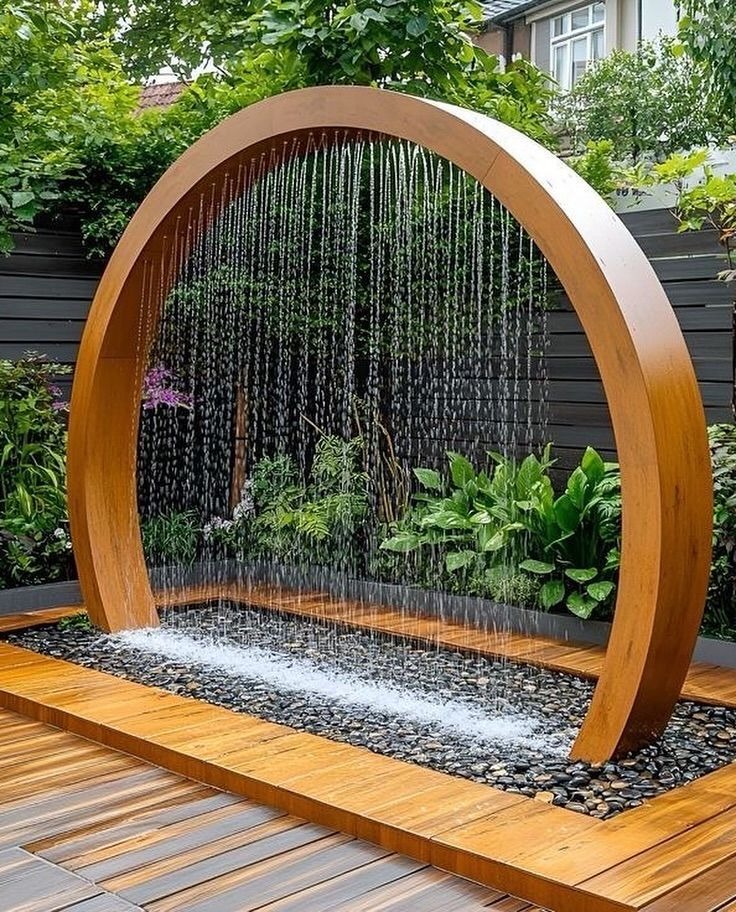
The striking architectural water feature shown here represents sophisticated engineering disguised as artistic simplicity—a rain curtain installation that transforms falling water into a living sculpture. At Ekjan Associates, we recognize these installations as technical achievements that demand precise hydraulic design, quality components, and careful execution to deliver the mesmerizing curtain effect that defines successful rain curtain systems.
Understanding Rain Curtain Hydraulics
Rain curtain systems create uniform sheets of falling water through precisely controlled distribution. The curved timber arch shown houses a concealed water distribution manifold along its upper edge—a perforated pipe or slotted channel that delivers pressurized water uniformly across the entire width. The engineering challenge lies in achieving perfectly even flow from every outlet despite varying distances from the water inlet.
Manifold Design Principles: Proper manifold engineering employs gradually decreasing internal diameter along the distribution length, compensating for pressure drop as water exits through successive outlets. Alternatively, strategically sized orifices—smaller near the inlet, larger toward the terminal end—balance flow distribution. Without these compensations, curtains display heavy flow at one end, diminishing toward the other.
Orifice Spacing and Sizing: The individual water streams visible in the image result from discrete outlet points spaced at intervals typically ranging from 10-25mm. Closer spacing creates denser curtains with more solid appearance; wider spacing produces distinct streams. Orifice diameter, typically 2-4mm, determines individual stream volume and affects overall visual character.
Pressure Requirements and Flow Dynamics
Creating stable rain curtains demands adequate water pressure—typically 1.5-3 bar—to project water forward slightly before gravity takes over. This initial velocity prevents water from running down the distribution manifold or backing structure, instead creating the free-falling curtain effect. Insufficient pressure results in water trickling down structural elements; excessive pressure creates spray rather than clean streams.
Flow Rate Calculations: A typical residential rain curtain spanning 1.5-2 meters requires approximately 30-60 liters per minute depending on orifice density and design aesthetic. The installation shown, with its substantial width and dense curtain, likely operates at the upper end of this range. Pump selection must account for both required flow volume and system head pressure, including vertical lift and friction losses.
Structural Integration
The beautiful curved timber frame serves multiple critical functions beyond aesthetics:
Concealment: Houses the distribution manifold, supply plumbing, and mounting hardware invisibly within its substantial profile.
Structural Support: Provides rigid mounting that prevents deflection or movement that would disrupt water distribution uniformity.
Visual Framing: Creates architectural presence that transforms functional water distribution into sculptural focal point.
Weather Protection: The overhead coverage protects distribution components from direct sunlight and environmental exposure.
The warm timber aesthetic contrasts beautifully with the dark horizontal slatted backdrop, creating depth and visual interest while the water curtain itself becomes the kinetic element connecting these static components.
Basin Design and Water Management
The collection system visible at the feature's base demonstrates proper rain curtain basin engineering:
Width Consideration: The basin extends well beyond the curtain width, capturing water despite wind drift or splash. The black river rock bed provides both aesthetic appeal and functional drainage surface.
Depth Requirements: Adequate basin depth accommodates the recirculation pump, provides water volume reserve, and allows space for filtration components.
Drainage and Return: The wooden deck planking creates clean architectural edges while concealing drainage channels that direct collected water to the pump intake point.
Splash Control: The dark stone surface absorbs water impact without excessive splash, maintaining the refined aesthetic while handling substantial water volumes.
Filtration and Water Quality
Maintaining the pristine curtain effect visible in the image requires effective water management:
Filtration: Suspended particles become immediately visible in clear falling water. Appropriate filtration—typically cartridge or sand filters sized for the system flow rate—maintains water clarity essential for visual appeal.
Water Treatment: Algae growth tints water green and clogs distribution orifices. UV sterilization or appropriate chemical treatment prevents biological growth while maintaining safe, clear water.
Mineral Management: Hard water deposits accumulate on orifices, disrupting flow patterns. Water softening or periodic acid cleaning maintains uniform distribution.
Installation Complexity
Despite their elegant appearance, rain curtain systems demand professional-level execution:
Precise Levelness: The distribution manifold must be perfectly level across its entire span. Even minor deviations create uneven flow distribution immediately apparent in the curtain appearance.
Structural Stability: The supporting structure cannot flex, settle, or move. Any structural shifts disrupt the carefully calibrated water distribution.
Hydraulic Balancing: Achieving uniform flow across all outlets requires systematic testing and adjustment during commissioning—an iterative process demanding patience and expertise.
Component Quality Imperatives
The seamless curtain effect shown depends entirely on quality components:
Distribution Manifold: Precision-drilled stainless steel or brass, with exact orifice sizing and spacing.
Pumps: Variable frequency drive pumps allow fine flow adjustment for optimal curtain formation.
Plumbing: Quality fittings and valves that maintain system integrity without leaks that compromise performance.
Control Systems: Optional automation enables scheduled operation, reducing water and energy consumption during unoccupied periods.
Technical Excellence, Artistic Result
Rain curtain features represent the intersection of hydraulic engineering and landscape architecture—where technical precision creates artistic expression through the medium of falling water.
Ekjan Associates provides the technical expertise and quality components that transform rain curtain concepts into flawlessly functioning reality.