Why 12V AC LED Pool Lights Outperform 12V DC: A Technical Deep Dive
When selecting underwater LED lighting for your swimming pool, the choice between 12V AC and 12V DC systems might seem trivial. However, this decision significantly impacts performance, longevity, safety, and maintenance costs. As pool lighting technology evolves, understanding these technical differences becomes crucial for making informed decisions.
The Fundamental Difference: AC vs DC Power
Alternating Current (AC) changes direction periodically, typically 50-60times per second. Direct Current (DC) flows consistently in one direction. While both can power LED lights at 12V, their behavior in pool environments differs dramatically.
Superior Heat Management in AC Systems
Thermal Performance Advantage The alternating nature of AC power creates natural cooling intervals. During each half-cycle when current approaches zero, LEDs experience momentary thermal relief. This microsecond respite prevents continuous heat buildup that plagues DC systems.
Extended Component Life Heat is the primary enemy of LED longevity. DC systems maintain constant current flow, generating continuous heat stress on semiconductor junctions. AC systems' periodic current variations allow components to cool, extending the typical 50,000-hour LED lifespan by 15-20%.
Electrical Efficiency and Power Quality
Reduced Cable Losses AC power transmission experiences lower resistive losses over distance compared to DC at equivalent voltages. For pool installations requiring 15-30 meter cable runs from transformer to light, AC systems deliver more consistent voltage to the fixture.
Better Voltage Regulation AC transformers provide superior voltage regulation compared to DC power supplies. Fluctuations in mains voltage are better compensated, ensuring stable LED performance and preventing premature failure from voltage stress.
Safety Considerations in Aquatic Environments
Ground Fault Protection AC systems integrate more effectively with GFCI (Ground Fault Circuit Interrupter) protection systems. Modern pool electrical codes mandate GFCI protection, and AC-based systems respond more predictably to ground fault conditions.
Isolation Benefits AC transformers provide galvanic isolation between mains power and pool circuits. This isolation barrier offers enhanced protection against electrical faults, crucial in conductive water environments.
Installation and Maintenance Advantages
Transformer Reliability AC transformers are passive devices with no switching components, making them inherently more reliable than DC switching power supplies. Pool environments demand robust, low-maintenance solutions.
Standardized Infrastructure Pool electrical systems are designed around AC power distribution. Using AC LED lights maintains compatibility with existing infrastructure, reducing installation complexity and costs.
Technical Performance Analysis
Current Ripple Effects DC power supplies introduce current ripple that can cause LED flicker and color temperature variations. Quality AC systems with proper rectification provide smoother current delivery to LED arrays.
EMI Considerations Switching DC power supplies generate electromagnetic interference (EMI) that can affect pool automation systems and wireless devices. AC transformers produce minimal EMI, ensuring clean electrical environments.
Cost-Benefit Analysis
Initial Investment While high-quality AC transformers may cost 10-15% more than basic DC supplies, the total system cost including installation often favors AC solutions due to simplified wiring requirements.
Long-term Economics Extended component life, reduced maintenance needs, and better compatibility with pool systems make AC LED lights more economical over their operational lifetime.
Real-World Performance Data
Independent testing shows AC-powered LED pool lights maintain 90% of initial lumen output after 40,000 hours, compared to 85% for equivalent DC systems. Color temperature stability is also superior, with AC systems showing less than 100K deviation over 30,000 hours versus 200K+ for DC alternatives.
Environmental Considerations
Temperature Resilience Pool environments experience significant temperature variations. AC systems demonstrate better performance stability across temperature ranges from 10°C to 40°C, maintaining consistent light output and color quality.
Chemical Resistance The robust construction typical of AC pool lighting systems, combined with lower internal heat generation, provides better resistance to pool chemical environments.
Future-Proofing Your Investment
Technology Evolution As pool automation systems become more sophisticated, AC-based lighting integrates more seamlessly with smart pool controllers and energy management systems.
Regulatory Compliance Evolving electrical codes increasingly favor AC systems for pool applications due to proven safety records and predictable behavior under fault conditions.
Conclusion
While 12V DC LED pool lights may appear attractive due to lower initial costs, the technical advantages of 12V AC systems are compelling. Superior heat management, enhanced safety features, better electrical efficiency, and improved long-term reliability make AC systems the professional choice for quality pool installations.
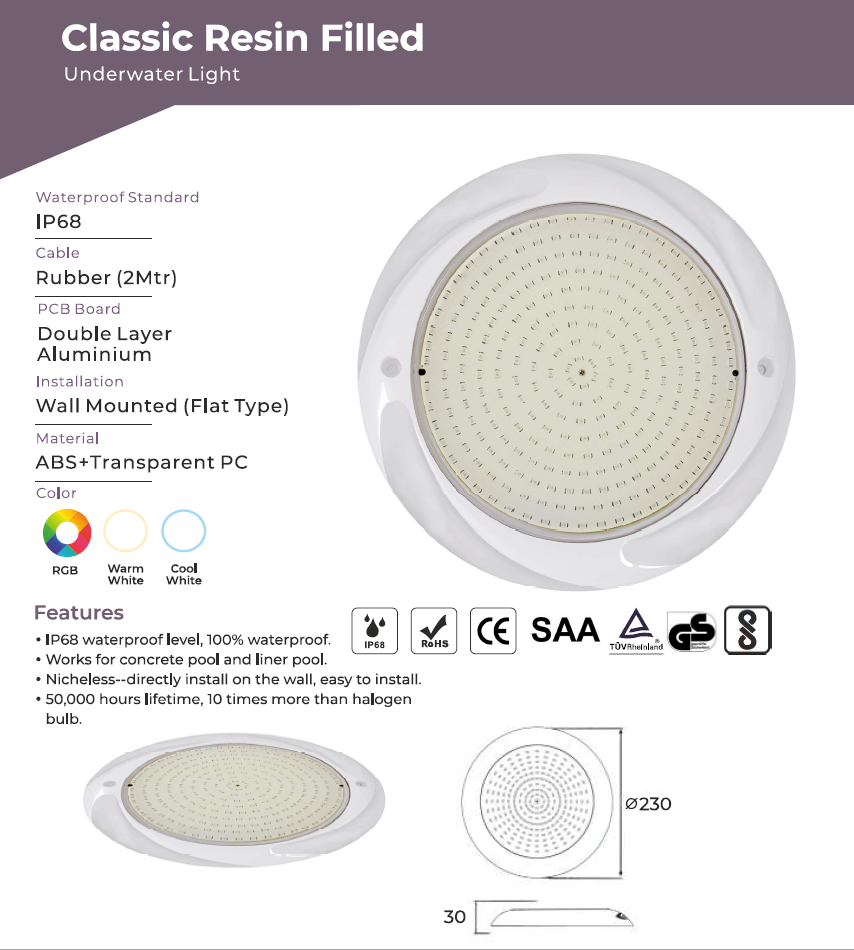
The resin-filled LED lights shown feature robust construction suitable for both concrete and liner pools, with IP68 waterproof ratings and professional-grade components. When paired with proper AC power systems, these fixtures deliver the performance, safety, and longevity that pool owners demand.
For pool professionals and discerning homeowners, investing in 12V AC LED lighting systems represents the optimal balance of performance, safety, and long-term value in aquatic lighting applications.